The Philadelphia Experiment: Fact or Fable?
Filed · FactorFable Editorial · Real ship, debunked legend
Case Status
15% Fact, 85% Fable
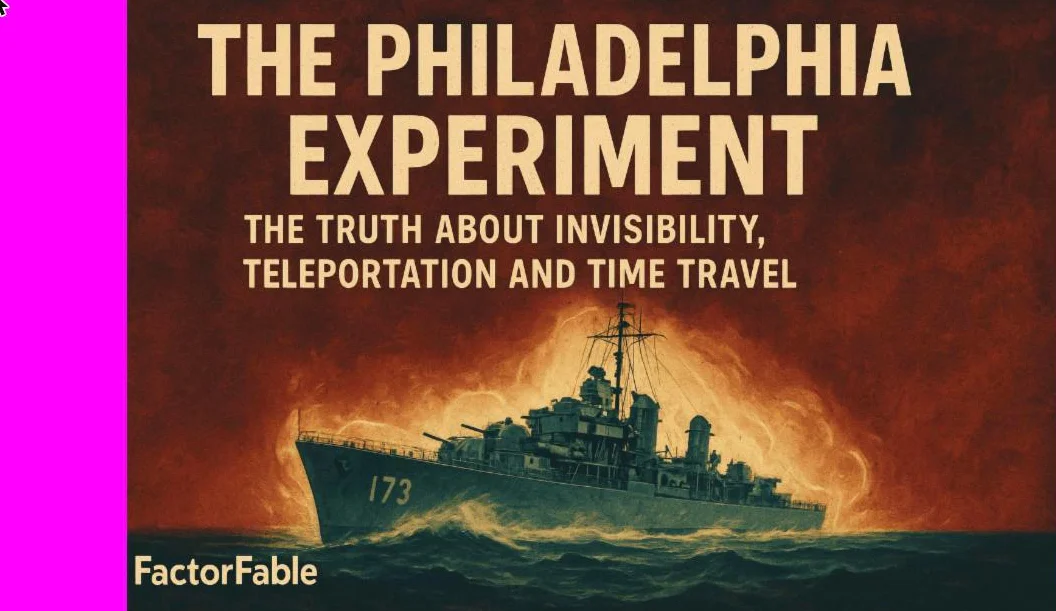
In the world of military secrets and conspiracy theories, few stories have captured the imagination as vividly as the Philadelphia Experiment. According to legend, in 1943, the U.S. Navy carried out an experiment so extraordinary that it seemed pulled straight from the pages of a science fiction novel. The goal? To render the destroyer escort USS Eldridge invisible to enemy radar. What allegedly happened next sparked decades of speculation, horror stories, and debates about the limits of human technology.
The Birth of a Mystery
The story begins at the Philadelphia Naval Shipyard during World War II. Naval forces were desperate to find an advantage against German U-boats, which were wreaking havoc in the Atlantic. Scientists were reportedly tasked with developing technology to hide ships from enemy detection.
What followed, if the tales are to be believed, was no ordinary military experiment. Witnesses claimed that the USS Eldridge not only became invisible to radar but to the naked eye itself. Some say the vessel was engulfed in a strange greenish haze before disappearing altogether. Even more bizarre, the ship was reported to have suddenly reappeared miles away in Norfolk, Virginia, before vanishing again and returning to Philadelphia.
Teleportation. Time travel. Invisibility. All supposedly achieved in one chilling experiment.
The Human Cost
But the real horror of the story lies in what happened to the crew. According to accounts, many sailors were left disoriented, some physically ill, and others fused to the ship’s bulkheads as though their bodies and the steel had merged. Rumors tell of men vanishing permanently, others going insane, and some fading in and out of visibility for the rest of their lives.
If true, this would mean the experiment didn’t just tamper with radar cloaking but disrupted the very fabric of time and space, using the crew as unwilling test subjects.
The Man Behind the Claims
The legend of the Philadelphia Experiment owes much of its life to Carl M. Allen, also known as Carlos Allende. In the 1950s, Allen wrote a series of letters to a researcher named Morris Jessup, describing what he claimed to have witnessed. His accounts fueled public fascination, but his credibility was questionable at best. Many dismissed him as a hoaxer, but the story had already taken root.
Science vs. Speculation
Skeptics argue that the Philadelphia Experiment was nothing more than a myth born out of misunderstanding and embellishment. Officially, the U.S. Navy has always denied such an experiment ever took place. According to historians, what might have inspired the tale were attempts to use degaussing techniques—methods designed to make ships less detectable to magnetic mines, not invisible to radar or the human eye.
Yet, for those who believe, the sheer number of strange details is too compelling to ignore. The idea of government experiments pushing the boundaries of physics has long fascinated the public. After all, if we were developing nuclear weapons at the time, why not invisibility or teleportation?
Why the Story Endures
The Philadelphia Experiment endures because it represents the ultimate clash between science and mystery. On one hand, it might be nothing more than an elaborate hoax, a conspiracy spun from paranoia and the fertile imagination of a few individuals. On the other hand, it taps into humanity’s greatest curiosities—what if time travel, invisibility, and teleportation were possible?
Movies, books, and documentaries have kept the story alive for decades, ensuring that the USS Eldridge will forever sail the waters of mystery, whether or not it ever vanished into thin air.
Final Thoughts
Whether the Philadelphia Experiment was real or a fable, it forces us to question how much we really know about military research during World War II. Could there have been experiments so strange, so dangerous, that they remain buried in classified files to this day? Or was it all just a story, exaggerated and retold until it became legend?
In the end, the truth may never be known. But one thing is certain: the Philadelphia Experiment continues to remind us that the line between fact and fable is often far thinner than we’d like to believe.
Advertisement