The Bootstrap Paradox: The Time Loop That Breaks Logic
Filed · FactorFable Editorial · Established concept
Case Status
Verified: theoretical concept
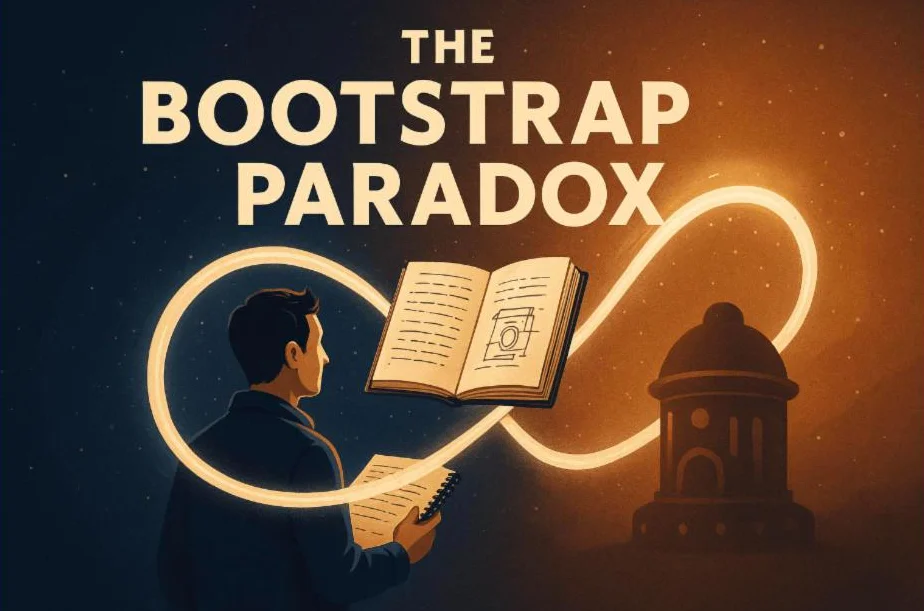
Imagine this — a scientist receives a mysterious notebook filled with detailed instructions on how to build a time machine.
Years later, using that very notebook, the scientist invents the first time machine. After finishing the work, they travel back in time and hand the notebook to their younger self — the same notebook that helped them build it in the first place.
Now the question is:
Who actually wrote the notebook?
That’s the Bootstrap Paradox — a mind-bending concept from physics and philosophy that challenges our understanding of cause and effect.
⚙️ What Is the Bootstrap Paradox?
The Bootstrap Paradox is a time travel paradox where an object, person, or piece of information is sent back in time and becomes the very cause of its own existence — creating a causal loop.
In simpler terms, it’s something that exists without a clear point of origin.
The term “bootstrap” comes from the old expression “pull yourself up by your bootstraps,” which means doing something impossible — like lifting yourself off the ground by your own shoes.
In this paradox, reality seems to do exactly that: it creates itself.
🧠 How It Breaks Cause and Effect
Our universe runs on the principle of cause and effect — A happens, therefore B happens.
But in a bootstrap loop, A causes B, and B causes A.
For example:
- A musician travels back in time and teaches Beethoven one of his own symphonies.
- Beethoven publishes it, and the musician learns it years later as “Beethoven’s work.”
- The question remains: who composed it first?
This circular logic makes the Bootstrap Paradox not just a curiosity, but a philosophical nightmare for physicists who believe in a timeline governed by logic and causality.
🧩 Famous Examples in Pop Culture
The Bootstrap Paradox shows up in science fiction all the time because it perfectly captures the eerie, impossible beauty of time travel.
- Doctor Who – The Doctor explains it with the example of Beethoven’s symphony.
- Predestination (2014) – A time travel movie that’s a textbook example of a bootstrap loop involving identity and destiny.
- Interstellar (2014) – While not a full paradox, the exchange of information through time between Cooper and his daughter has a bootstrap-like flavor.
- Harry Potter and the Prisoner of Azkaban – Harry saves himself from Dementors using a spell he learned because he had already seen himself do it.
🔄 The Philosophical Dilemma
The Bootstrap Paradox raises uncomfortable questions about the nature of existence:
- Can information exist without an origin?
- Is the universe deterministic — a perfectly repeating loop?
- If time travel ever becomes real, would we be stuck in endless cycles of self-created reality?
Some theories in physics, such as block universe theory, suggest that time is not linear but static — meaning the past, present, and future all exist simultaneously.
In that case, bootstrap loops might not be paradoxes at all — they’re just part of the structure of reality.
🚀 So, What Does It All Mean?
The Bootstrap Paradox doesn’t just mess with timelines; it messes with meaning itself.
It shows that knowledge, creation, and existence might not always have a beginning or an end — that perhaps, some things simply are.
Whether it’s a melody, a book, or a time machine manual, the paradox reminds us of one mind-twisting truth:
Sometimes, the effect becomes the cause, and the cause becomes the effect — forever feeding itself in an infinite loop of existence.
💭 Final Thought
The Bootstrap Paradox isn’t just about time travel — it’s about how fragile our sense of “reality” really is.
If a loop can exist without a beginning, maybe the universe itself is one giant bootstrap — endlessly creating, repeating, and rewriting its own story.
Advertisement